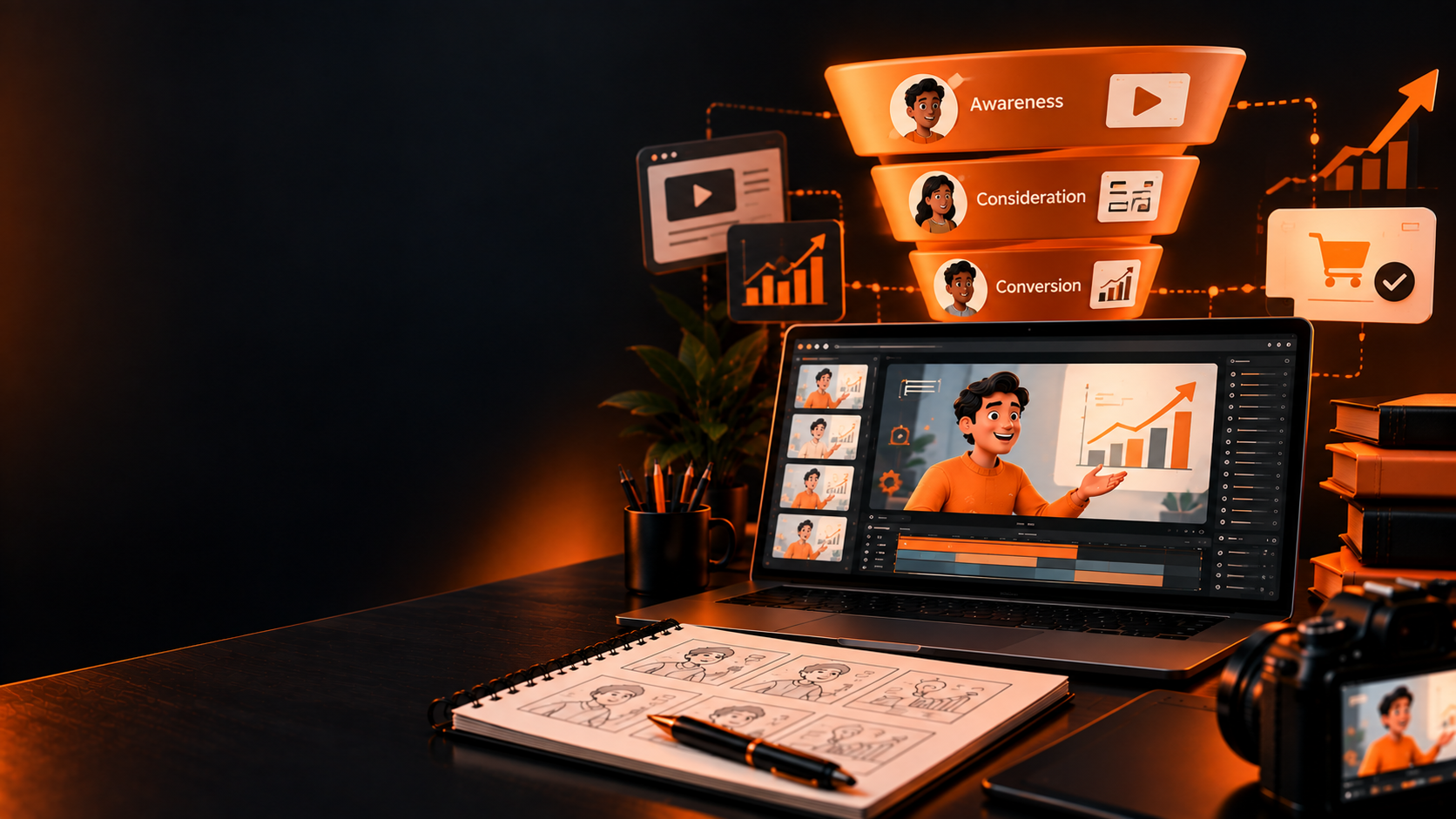

23 real videos from two SaaS brands, Epicor and Aiven, organized by the funnel stage each was built for, with a breakdown of what makes each one work.
SaaS buyers don't convert after one video. Epicor and Aiven built libraries of animated videos matched to each funnel stage: problem-framing at the top, vertical and product explainers in the middle, and demos, customer stories and industry use cases at the bottom. Here are all 23, stage by stage.
A mid-market manufacturer evaluating ERP, or a platform team comparing managed databases, doesn't decide after one video. They go through several stages. First they recognize a problem. Then they compare ways to solve it. Finally they look for proof that a particular vendor won't let them down. Each stage raises a different question, so each needs a different video.
The SaaS companies that use animation well don't stop at a single hero explainer. They build a library of videos, each designed for one stage and one audience. Epicor and Aiven are two of the clearest examples from our own work. One is an established ERP vendor selling into many verticals, the other a cloud data platform with a growing product family.
| Stage | Buyer's question | Video job | Examples below |
|---|---|---|---|
| Top Awareness | "Do I have a problem?" | Educate, reframe the problem, build brand recall | Industry 4.0 series · Great Refresh |
| Mid Consideration | "What solves it, for someone like me?" | Vertical and product explainers that handle objections | LBM, FFL, ECM · PostgreSQL, BYOC |
| Bottom Decision | "Can I trust this vendor?" | Demos, customer stories, industry use cases | Tusco, MHC, RAH · Software, Retail |
For individual examples from other brands, see our roundups of the 25 best SaaS explainer videos and best SaaS video ads. If you're still deciding which formats to make, start with our guide to the 10 types of SaaS videos. This post is different: it follows two companies through their entire funnel.
ERP and retail software sold to manufacturers, lumber yards, hardware stores, firearms dealers and garden centers. Vertical explainers in the middle, thought leadership at the top, customer proof at the bottom.
Opens with the question mid-market manufacturers are actually asking: Industry 4.0 is coming, but how and when does it affect my plant? No product pitch up front, just the problem framed clearly.
It starts from the buyer's uncertainty instead of Epicor's capabilities. That earns attention from people who aren't shopping for ERP yet.
Top-of-funnel videos should answer the buyer's question, not introduce your product. Let the product show up later.
Builds on Part 1 by showing how machine-to-machine and machine-to-part connectivity turns raw data into better insight and customer service.
It moves the viewer from 'what is it' to 'what's in it for me' by tying connected machines to outcomes a plant manager cares about.
Split a big topic into a series. Each part stays short, and each one gives you another reason to follow up.
Closes the series by cutting through the noise around mobile, analytics, cloud and IIoT, and sets up the readiness conversation Epicor's sales team wants to have.
It acknowledges the flood of information buyers are dealing with and positions Epicor as the calm, credible guide.
End an awareness series by setting up the next step, so it hands off naturally to your consideration content.
Speaks straight to independent retailers losing shoppers to big-box stores and online sites, then positions the Eagle N Series as the way to fight back.
It names a fear every independent retailer has, and the hand-drawn whiteboard style feels approachable to small-business owners.
Pick an animation style your audience will relate to. For owner-operators, approachable often beats slick.
Made for lumber and building-materials dealers. Puts a price on sticking with manual, outdated systems, which is exactly the argument a buyer needs to take to their CFO.
The 'seven costs' structure makes the cost of doing nothing concrete and easy to list, and characters make it feel like the viewer's own business.
Mid-funnel videos should arm your champion. Give them the argument they'll repeat internally.
Explains why 'any old' document management system won't do once compliance and business continuity are on the line, and where Epicor ECM fits in.
It raises the stakes (compliance, continuity) before it differentiates, so the product arrives as the answer to a real risk.
Explain why the obvious cheap option isn't enough before you pitch your own solution.
A vertical-specific explainer covering acquisition and disposition records, inventory tracking, range safety and compliance, all in the buyer's own language.
Every scene uses terms that only a firearms retailer would recognize, which instantly signals 'this was built for you.'
One product can support many vertical videos. Using the niche's own vocabulary is what makes a generic platform feel purpose-built.
Takes on the 'new tech is too expensive and I don't have time' objection head-on for lawn and garden retailers who are stuck on manual processes.
It addresses the real objection (cost and time) directly instead of dodging it with a feature tour.
Build at least one mid-funnel video around your most common sales objection.
At 3:45 this is the long-form demo, built for buyers who are already evaluating. It walks through how the platform actually changes day-to-day operations.
Length is a feature here. Evaluators want detail, and a structured animated demo keeps it clear where a screen recording would drag.
Bottom-funnel videos can run long. The viewer has opted in, so depth beats brevity. See more in our best animated software demo videos.
A retail-display manufacturer that grew around 800% since 1979 and now serves 400+ clients tells its own story. This is social proof delivered right when a buyer needs reassurance.
"Specific growth numbers from a real customer do more to close a deal than any feature list."
The customer tells the story, not the vendor. Hard numbers (800% growth, 400+ clients, a 110,000 sq ft plant) do the persuading.
Sales reps can send this after the demo to buyers asking 'has this worked for a business like mine?'
A family hardware store founded in 1954 and now running four Florida locations explains why it chose Epicor. Relatable proof for independent retailers.
A long-running family business is exactly the peer an independent retailer trusts, and it lowers the perceived risk of switching.
Match customer stories to the prospect's size and segment. A peer beats a big-brand logo.
Started in 1946 and now has 90+ staff across three Michigan stores. They outgrew their old system and describe the switch to Eagle N Series.
The 'we outgrew our old system' story mirrors exactly where Epicor's prospects are.
Three short customer stories cover more buyer types than one long one.
A cloud data platform with managed PostgreSQL, ClickHouse, BYOC, Inkless and more. A brand layer on top, a consistent product series in the middle, and industry use cases at the bottom.
Aiven's 2026 brand repositioning in 42 seconds: 'the bridge between the builder's speed and the architect's rigor.' Short and punchy, made for social and paid.
It compresses a positioning shift into one memorable line and a clean visual rhythm, built to stop the scroll.
Brand videos at the top of the funnel should run under a minute and focus on one idea.
The company intro and the first touchpoint for someone who has never heard of Aiven.
It gives a fast, confident answer to 'who are you?', which every homepage visitor asks.
Keep a short intro video ready for your homepage, email signatures and first-touch outreach.
Frames data infrastructure as the backbone of every enterprise across retail, software, manufacturing and finance, then introduces the platform as the answer.
It opens broad and cross-industry, then narrows to the platform, so every visitor sees their own industry first.
A platform overview works as the hub video that your product and industry videos branch off from.
The launch-announcement cut of the same product: shorter, higher energy, and made to create buzz rather than explain.
The same product gets a second cut tuned for announcement channels, which gets more value out of the same assets.
Plan launch and explainer cuts together. Reusing assets makes the second video much cheaper.
A product-line explainer for one of Aiven's core managed services, produced in B2W's AI-assisted video style for faster turnaround.
AI-assisted production keeps a growing product series fast and consistent without spending premium budget on each one.
Use premium production for flagship pieces and AI-assisted production for high-volume product explainers.
A companion explainer for the analytics offering. Same format as PostgreSQL, so the product family feels consistent.
Matching format across product lines makes the portfolio feel like one coherent platform rather than separate tools.
Template your product explainers so every new product launch gets a video quickly.
Opens on a pain buyers feel right now, rising cloud costs and complexity, then shows how BYOC gives back control while Aiven's experts run the infrastructure.
It leads with the pain (cloud bills) before the product, and characters make an abstract deployment model relatable.
When the product is abstract, use characters and a problem the viewer feels today.
The detailed product explainer for Inkless, built for technical evaluators who want to know how it works.
It gives technical evaluators the depth they need without forcing marketing-level viewers to sit through it.
Separate 'how it works' from 'why it matters' so each audience gets the right video.
'Speed isn't a nice-to-have.' Positions legacy apps as anchors and Aiven as the way out, written in the language a software CTO uses.
"Legacy applications are framed as anchors, a metaphor any CTO under pressure to ship faster will recognize."
It leads with the buyer's competitive fear (speed) before it mentions the product. Pain, stakes, then solution.
Use it on industry landing pages and in ABM sequences aimed at software companies.
Links real-time data infrastructure directly to personalized customer experiences and revenue, which is the outcome retail leaders get measured on.
It translates infrastructure into the retail executive's metric: revenue from personalized experiences.
Industry videos should end on the KPI that industry's buyer reports on.
A celebrity endorsement floods a sports retailer's site. One concrete scenario makes an abstract database benefit instantly clear.
A vivid 'what if' scenario (sudden traffic surge) turns scalability from a spec into a story.
Scenario-led videos make abstract features memorable. Pick the moment your product saves the day.
They lead with the buyer's problem before the product. Epicor's LBM video opens with "seven costs of outdated software," and Aiven's BYOC video opens with rising cloud bills. Neither mentions itself until the viewer already feels the problem.
They match production value to the stage. A 42-second brand piece sits at the top, while a 3:45 ECM demo sits at the bottom, where the viewer is already committed. AI-assisted production kept Aiven's product series fast and consistent. (More on this in how to improve your video ROI with animation.)
They let customers close the deal. Epicor's three customer stories, from businesses founded in 1946, 1954 and 1979, show buyers that a company like theirs made the switch and it worked.
They built series, not one-offs. A three-part Industry 4.0 series, a matched PostgreSQL and ClickHouse pair, and an Inkless explainer plus launch cut. Series make each additional video cheaper and build familiarity every time a buyer sees one.
Start with where deals stall:
• Prospects don't understand the category: invest at the top with problem-framing explainers. Our guide to marketing complex SaaS products with video covers this in depth.
• They understand it but pick competitors: build vertical or use-case explainers for the middle, and pair them with the B2B SaaS lead generation strategies that get them in front of the right accounts.
• They stall at procurement: add a demo and two or three customer stories.
Most SaaS teams we work with start with three to five videos across the stages and add more as they learn which ones sales actually sends. That's what our SaaS video production team does every week.
At least one per stage: an awareness explainer, a solution or product explainer, and a proof piece such as a demo or customer story. Companies selling into several verticals or with several products, like Epicor and Aiven, benefit from one mid-funnel video per vertical or product line.
It depends on the stage. Infographic animation handles data-heavy explanations well, character animation humanizes pain points (Epicor LBM, Aiven BYOC), whiteboard suits step-by-step education, and AI-assisted video keeps large product series fast and affordable.
Top-of-funnel pieces work best under 90 seconds, and some, like Aiven's Great Refresh, run about 40. Mid-funnel explainers usually land between 90 and 140 seconds. Bottom-funnel demos can run three minutes or more because the viewer has already opted in.
Broadcast2World is a US-based animated video production company with 15+ years of experience and 2,400+ videos produced, including full-funnel SaaS video programs for Epicor and Aiven. See our SaaS video production services
A 60-second animated video at B2W typically starts around $3,000, and series pricing drops per video because styles and assets are reused. Standard turnaround is 4-6 weeks, with a 2-week rush available. Request a free quote
The best SaaS video programs aren't built around one great explainer. They're built around the buyer's journey. Epicor and Aiven both started with the question each stage raises, then made the video that answers it. The funnel decided the script, and that's why their videos move deals forward.

Marcus is a distinguished artist with a deep-rooted passion for visual storytelling, specializing in video marketing and animation. Outside of his professional sphere, Marcus is an avid biker, often taking to the open roads to find inspiration for his creative ventures.
We've helped Epicor, Aiven, AWS, Siemens and hundreds of other brands turn complex software into animated videos buyers actually watch.
US Office (Support)
371 Hoes Lane, Suite 200, Piscataway, New Jersey - 08854
US (Toll Free): 1800-571-2725
(Render 5 Technologies Pvt. Ltd.)
India Office (Production)
WeWork, 246, Udyog Vihar,
Gurugram, Haryana - 122016
IND: (+91) 98713 30069
SERVICES
ANIMATION STYLES
INDUSTRY
Copyright © 2026 Broadcast2World, Inc. All Rights Reserved.


No Comments Yet
Let us know what you think