



You've been in that meeting. Someone asks why the pipeline is stalling — the demos go well, the prospect seems interested, and then nothing. Three weeks of silence. The problem usually isn't the product. It isn't the pricing. It's that somewhere between "I've heard of them" and "I'm confident signing this," the buyer ran out of reasons to trust you.
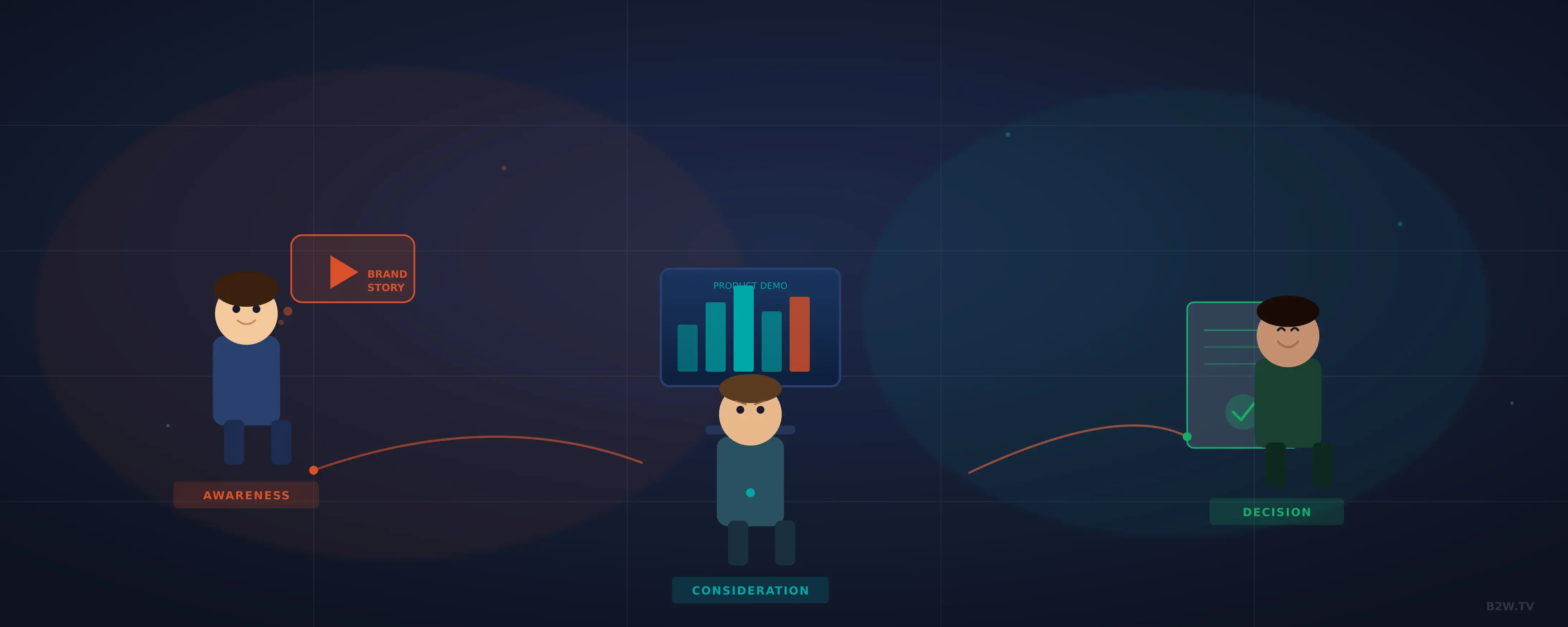
That's the trust gap — and most B2B video strategies ignore it entirely. Explainer videos get treated as either a top-of-funnel awareness tool or a bottom-of-funnel conversion push. What gets skipped is everything in between: the stage-by-stage trust signals that keep a prospect moving forward across a weeks-long, multi-stakeholder buying journey. This article is about filling that gap — with the right video format mapped to each stage: education and credibility at awareness, solution-fit and empathy at consideration, and proof-driven confidence at the decision-making stage.
88% of buyers today say that trust is just as important as price and quality, showing that credibility now plays a major role in purchase decisions. Yet most B2B video content is still optimised for clicks, not credibility.
The problem is structural — and it feels familiar. Your prospect watches a demo in week one and finds it impressive. By week four, they're still comparing. By week eight, a competing brand they've seen more often feels like the safer choice — even if your product is objectively better. Not because you lost on merit. Because you lost on trust. B2B buying cycles are long, involve multiple stakeholders, and carry significant perceived risk. A prospect can watch your best video and still not commit for three months. What keeps their confidence intact across that entire journey isn't more content. It's trust built at the right moment, in the right form.
Explainer videos are uniquely positioned to build that trust — not because they explain things, but because the right explainer video makes your buyer feel something specific at a specific moment. Educated and credible when they're not yet problem-aware. Understood and guided when they're actively researching. Confident and de-risked when they're comparing vendors and ready to commit. If you're new to the format, our overview of the benefits of explainer videos covers the fundamentals. What follows goes deeper — mapping each stage of the buyer journey to the trust trigger it demands, and the video format built to deliver it.
At the awareness stage, your prospect isn't actively looking for a solution — because they haven't fully identified the problem yet. They're not comparing vendors. They're not in a buying cycle. They're just living with a challenge they may not have named. The goal here isn't to pitch; it's to be the brand that educated them before they knew they needed help. That's how trust gets built before a buying signal ever appears.
Content at this stage should focus entirely on education — industry trends, thought leadership, and category-level insights that are genuinely useful regardless of whether the viewer ever buys from you. The brands that win consideration later are almost always the ones that showed up first with something worth learning.
Educational explainer videos, industry trend videos, and thought leadership content are the formats built for this moment. A well-crafted 60–90 second animated explainer that makes a complex industry concept clear — without mentioning your product once — does more for long-term brand trust than any promotional video at this stage. The Why-First Framework makes this principle explicit: the opening frame should reflect the viewer's world, not the brand's offer. That recognition is the first unit of credibility.
Take Uproas, a platform providing agency ad accounts and Meta ad infrastructure for advertisers looking to scale campaigns. A brand in their category earns awareness-stage trust not by explaining their product, but by creating content that helps performance marketers understand the structural reasons their campaigns underperform — the platform constraints, the account limitations, the attribution gaps. When a viewer encounters that kind of genuinely useful content, they don't think "I'm being sold to." They think "this brand understands my world." That's the credibility foundation that makes every subsequent stage easier.
Alongside educational content, brand awareness videos serve a distinct and often underestimated trust-building function — particularly for newer brands entering a market. Many companies produce short brand awareness videos, typically 30–40 seconds long, that are not designed to explain a product in depth or drive immediate conversions. Their purpose is more foundational: introduce the brand, communicate what it stands for, and create a positive first impression with potential buyers who don't yet have a buying need.
The trust mechanism here is rooted in psychology. When a prospect eventually encounters a relevant problem and begins researching solutions, they will instinctively gravitate toward brands they recognise. A company they've seen before — even briefly, even without fully understanding what it does — carries an inherent credibility advantage over a competitor they're discovering for the first time at the moment of evaluation. That recognition isn't neutral; it's positive. The brain associates familiarity with safety. A brand that feels known feels trustworthy, even before a single claim has been evaluated.
This is why short brand awareness videos function as trust deposits rather than conversion tools. Every impression — a 35-second animated video on LinkedIn, a brand spot before a YouTube tutorial, a consistent visual identity across multiple touchpoints — is a small investment in the credibility account your sales team will draw from months later. When a prospect encounters the same animation style, colour language, and motion rhythm across channels, their brain registers your brand as established and legitimate. Credibility compounds through consistency. The awareness-stage job isn't to convert; it's to make your brand feel like it belongs in the category — so that when the buying need finally arrives, you're already on the shortlist.
By the consideration stage, the prospect knows they have a problem and is actively researching ways to solve it. They're reading comparisons, watching demos, and evaluating whether different solutions actually fit their situation. The trust mechanism here shifts from education to empathy — your buyer needs to feel that your brand understands their specific challenge, not just the category. The message that earns trust at this stage isn't "here's what we do." It's "if you're facing this problem, here's exactly how we help solve it."
Product explainer videos and solution-focused videos are the primary formats for this stage. Done well, a product explainer collapses the perceived complexity of your offering into a clear, logical sequence that shows the prospect not just what the product does, but why it exists — and what life looks like after the problem is resolved. The structure that works best at this stage is: name the pain the viewer is living with right now, show the mechanism that resolves it, then make the transformation visible.
The consideration stage is also where brand story videos built around a clear problem narrative earn their keep — not as broad awareness plays, but as proof that the brand genuinely understands the challenge the prospect is researching.
Case study videos and customer success story videos are particularly powerful at the consideration stage, because they answer the precise question an active researcher is asking: "Has this solution worked for someone in a situation like mine?" A two-minute animated case study that moves from a named problem to a measurable outcome gives the prospect a peer-level reference point — which is far more persuasive than any product description.
For brands with complex or multi-use-case products, the most effective consideration-stage strategy is a small library of short, use-case-specific videos — each one addressing a different version of the prospect's problem — rather than a single all-purpose explainer. That specificity is what signals genuine understanding and converts a researching prospect into a sales conversation.
At the decision-making stage, the prospect has narrowed their shortlist and is now comparing vendors side by side. They're not looking for new information — they're looking for reasons not to be wrong. The weight here isn't strategic; it's personal. This is the buyer who has to stand up in a room and defend the choice they're about to make. The trust trigger at this stage is confidence through proof — giving the prospect the concrete evidence they need to commit, and making your brand feel like the lowest-risk option on the list.
Product demos and product walkthrough videos are essential at this stage — but the framing matters enormously. A demo that leads with features feels like a sales presentation. A demo that leads with the prospect's specific workflow, then shows exactly where the product intervenes and what changes, feels like a preview of the solution they're about to own. That distinction — from "here's what it does" to "here's what your day looks like after" — is what makes decision-stage demos convert.
Consider Sellermetrics, a B2B analytics platform for Amazon sellers evaluating their ad spend. A prospect at this stage isn't wondering whether analytics tools exist — they're deciding whether Sellermetrics fits their specific workflow better than the two competitors they've already demoed. An animated product walkthrough that mirrors their exact data challenge, then shows the platform resolving it with precision, gives them a concrete reason to choose — not just a reason to consider.
Customer testimonials and ROI-focused videos carry particular weight at the decision-making stage because they answer the question no product demo can: "Has this worked for someone like me — and what did they actually get out of it?" A 60–90 second testimonial that leads with the prospect's original doubt, then walks through the outcome with specific numbers, gives the buyer's internal champion the evidence they need to make the case to a CFO or procurement team.
For a company like Bay Alarm Medical, customer-outcome videos are central to building the purchase confidence their buyers need before committing. Their content emphasises specific, tangible outcomes — response times, ease of setup, real user experiences — rather than product specifications. The same logic applies directly in B2B: the most persuasive decision-stage video is a real customer describing a real result, told with enough specificity that the prospect can project themselves into the same outcome.
Brand Story and Values Videos: Reducing Risk Through Identity
One underused format at the decision-making stage is the brand story or company values video. When a prospect is choosing between two vendors with similar capabilities and pricing, the tiebreaker is often trust in the people behind the product — not the product itself. A short, honest brand story that communicates who built this, why, and what they genuinely stand for reduces the perceived risk of committing to an unfamiliar company. It answers the question that every shortlisted vendor eventually faces: "Can I trust these people when something goes wrong?"
The final trust gap in B2B buying often happens internally. Your main point of contact may already believe in your product, but they still need to convince a CFO, procurement lead, or legal team that has never encountered your brand. An ROI-focused video built for internal sharing — one that leads with business outcomes, frames the investment against measurable return, and keeps the product in the background — gives your champion something credible to carry into that conversation.
Research on how explainer videos increase conversion rates consistently shows that adding video to proposal or pricing pages improves close rates. A well-framed ROI video brings a human voice into what would otherwise feel like a cold document exchange — and at the decision-making stage, that human presence is often the difference between a stalled deal and a signed one. Once the decision is made, customer onboarding videos carry the trust-building work forward — reassuring new buyers that committing was the right call.
Use this table to audit your current video stack. If any stage is missing its trust trigger, that's the gap most likely to be bleeding pipeline.
Most explainer video briefs open with: "Here's our product, here's what it does, here's who it's for." The Why-First Framework™ inverts that entirely. A trust-led brief opens with the viewer's belief, then the pain they're living with, then the transformation they're hoping for — and only then, the product that makes it possible. Before you brief your next video, these five questions will tell you whether you're building trust or just creating content.
Brand trust isn't a single moment — it's a sequence that follows the shape of your buyer's journey. It starts long before the buying need exists: with educational content at the awareness stage that makes your brand feel knowledgeable, credible, and worth returning to. It deepens at the consideration stage, when a prospect who's actively researching encounters a video that reflects their exact challenge and shows a clear path to resolution — not a product pitch, but a genuine answer. And it closes at the decision-making stage, when a demo, a testimonial, or a brand story gives the buyer the confidence they need to commit in a room full of sceptics.
The Why-First Framework™ exists because the order of those moments matters. Credibility before solution-fit. Solution-fit before proof. Proof before the ask. Brands that respect that sequence build trust the way trust actually works — stage by stage, format by format, feeling by feeling. The brands that skip straight to features, pricing, and CTAs are producing content that informs but doesn't move.
If your current video stack is missing any stage, that's where to start. Audit what you have against the Format–Trust Trigger Map. Identify the stage where your buyer's confidence most often stalls. Then brief one video — correctly scoped, built around the specific trust trigger that stage demands — and measure what changes. Open with the viewer's world. Speak to the problem they're living with. Show what life looks like after. And if you have a genuine differentiator, show it once, specifically, and let it speak for itself. That's the brief. That's the framework. That's how explainer videos build brand trust at every stage of the buyer journey.
Fabi Pina is the Content Director at Startupresources.io. She writes about startups, with a focus on branding, design, and digital marketing.
No Comments Yet
Let us know what you think