
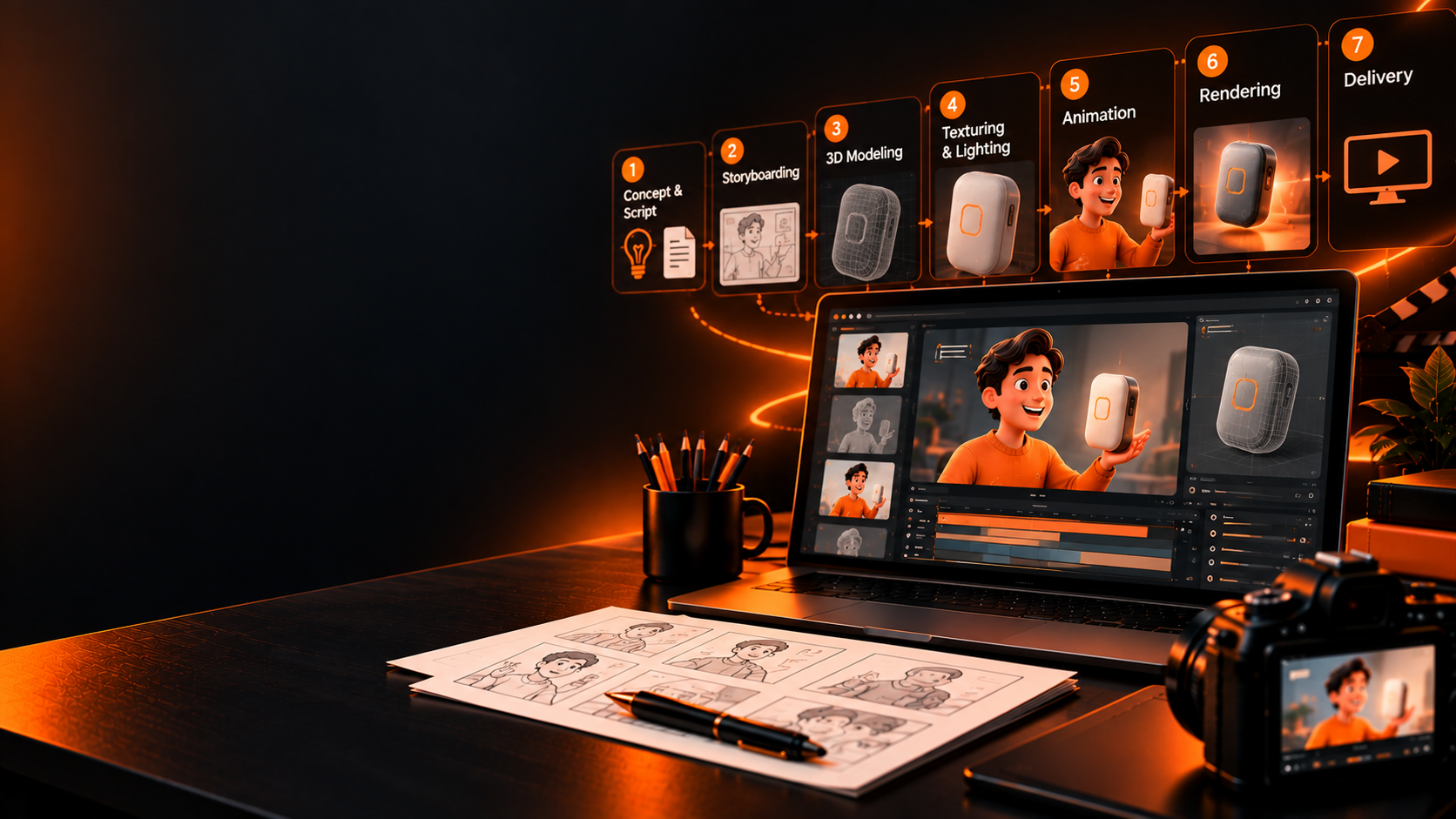

A 3D product animation video builds your product as a digital model and moves a virtual camera around it, inside it and through it, so buyers can see how it works. The ones that sell pair those 3D shots with motion graphics: labels, callouts, data and interface screens that explain what the viewer is looking at. Making one takes eight steps, from script to final render, usually over 4 to 6 weeks. Below is the full process, what drives timing and cost, and 14 real examples from our studio.
A 3D product animation video is a short film built around a digital model of your product. Because the model exists only in software, the camera can go anywhere a real camera can't: through a casing, inside a valve, around a device as it's being used, or into the body where an implant does its job.
If 3D is more than you need, see how to make an animated explainer video in 2D, motion graphics or whiteboard.
For B2B products, 3D on its own rarely tells the whole story. A beautiful turntable shows what the product looks like. It doesn't explain why it matters. That's why we almost always combine 3D with motion graphics (often called 3D motion graphics), which is our core craft. The 3D carries the hero shots. The motion graphics carry the explaining: labels that name each part, callouts that point at the feature that matters, data that proves the claim, and interface screens that show the software side.
Facts don't win hearts, stories do. A spec sheet turned into a 3D render is still a spec sheet. What works is a story where the buyer's problem comes first and the product arrives as the answer, with each 3D shot doing one job in that story.
If you're weighing the two styles, our guide to 2D vs 3D animation covers the tradeoffs, and types of motion graphics shows what the 2D layer can do.
Here's how to create a 3D animation video for a product, from first brief to final file, the same way we do it. The order matters, because every hour spent getting the script right saves days in rendering later.
Want the full picture of how a project runs? See our video production process.
A 60 to 90-second 3D product video with motion graphics usually takes 4 to 6 weeks. A simpler scope, with a CAD model ready and fewer shots, can be done in about 2 weeks. Four things move the timeline most:
At Broadcast2World, a 60-second video in our Premium style, mixing 3D product shots with motion graphics, typically costs around $4,200 to $4,600. A fully 3D production in our Flick style is about $8,100 for 60 seconds. A 30-second version costs roughly half, and a 90-second version about 1.3 times as much. The biggest cost drivers are the share of shots that need full 3D and how detailed the product is. For a full breakdown across styles, see how much animation costs.
Every example below is our own work, grouped by the kind of product. Each one mixes 3D with motion graphics in a different way. Click any card to watch it, then read why it works and what you can borrow for your own video.
Devices, implants and procedures where 3D shows what no camera can reach and motion graphics name every part.
A step-by-step 3D walkthrough of a medical device used in fat-removal procedures, showing each stage of use in order.
The 3D model can be turned to the exact angle a clinician needs, so every step is clear without a single photo shoot.
For any device that needs instructions, build the how-to in 3D. One model gives you training, sales and support videos.
A 2025 film for CDL Nuclear Technologies on its custom cardiac PET imaging, combining 3D equipment with motion graphics for patient care data.
Clean motion graphics carry the clinical detail, so the 3D shots can stay focused on the technology.
Let 3D carry the "what" and motion graphics carry the "why". It keeps a medical story easy to follow.
A 3D tour that takes healthcare providers inside CDL's mobile cardiac PET trailer, from the control room to the PET/CT scanner.
The camera walks the viewer through the trailer like a site visit, so a big capital decision feels concrete.
If your product is a space or a system, give the viewer a guided 3D walkthrough instead of a list of features.
A 3D procedure video showing clinicians how to use BD's Touchless Plus pre-lubricated urinary catheter kit, item by item.
Every component is modeled and labeled, so the steps are unambiguous in a way live-action rarely manages.
For procedure videos, label every item the first time it appears. It removes guesswork for the viewer.
A 3D product explainer for Breg's QuantumOA osteoarthritis knee brace and its dynamic pull system.
Animated force arrows show the brace unloading the knee in the last 30 degrees of extension, which no photo could show.
When your product works through forces or motion, animate the force itself. It turns a claim into something visible.
A 3D explainer that traces the science of drug-free pain relief, from gate control theory to MMJ Labs' vibration device.
It opens with the problem (the opioid crisis) before the product appears, so the device arrives as the answer.
Start with the problem your buyer already feels. Introduce the product only once they want a solution.
A motion graphics explainer for OrthAlign's compact navigation technology for knee and hip replacement surgery.
Infographic motion graphics make the business case (accuracy, cost, space in the OR) alongside the 3D anatomy.
B2B medical buyers need the business case too. Put the ROI on screen next to the clinical story.
A mixed media film tracing Ethicon's history of surgical innovation since 1886, with 3D sutures and instruments.
3D product shots give a heritage story a modern finish, so 140 years of history still feels current.
Even a brand film can feature the product. A few 3D hero shots tie the story back to what you sell.
Physical products with hidden mechanics, where cutaways and exploded views do the selling.
A 3D explainer for 3Flow's fume hood airflow system, showing how it cuts lab energy use without compromising safety.
Airflow is invisible, so the animation makes it visible with 3D particles and motion graphics data on energy use.
If your product changes something invisible (air, data, heat), animate that change. It's the proof buyers need.
A 3D product video for LSP's One Stop box, a universal outlet box for washing machines, ice makers, gas and drains.
Exploded views show every configuration from one model, so a product with many versions is explained in under two minutes.
For a product with many variants, build one 3D model and animate each configuration rather than filming them all.
Software, networks and lab systems, where 3D turns an abstract system into something you can see.
A 2025 isometric motion graphics film for Telin's subsea cable system, built for AI models and cloud workloads.
Isometric 3D turns a global network into a clear map, and motion graphics show data moving across it.
Use isometric 3D when the product is a network. It shows scale without losing clarity.
A 3D explainer for Align that moves from the workplace to the data center and into the cloud in one continuous camera move.
A single journey through 3D spaces links services that would otherwise feel like a list.
If you sell several services, connect them with one camera path. It shows they work as one offer.
A 3D explainer showing how attackers target backups, and how Asigra's approach keeps data clean.
The threat is staged in 3D before the product appears, so the viewer understands the risk first.
For security products, show the attack before the defense. The solution only matters once the threat is real.
A 3D explainer for the Presto system co-developed by Thermo Fisher Scientific and Hamilton, automating forensic DNA extraction.
The 3D model of the instrument is paired with motion graphics that show throughput (96 samples in about an hour).
Pair your hero 3D shot with one hard number on screen. The image builds desire and the number builds trust.
You can learn to make 3D animation yourself, and for some jobs that's the right call. For a product video that buyers will judge your company by, it usually isn't.
Planning to try it yourself first? Our guide to making animated videos is a good starting point.
Most studios work across three groups of tools. For 3D modeling and animation: Cinema 4D, Blender or Autodesk Maya. For motion graphics and compositing: Adobe After Effects. For rendering: engines like Redshift, Octane or Blender's Cycles, often on render farms. CAD files usually come in from engineering tools like SolidWorks.
Throughout a project, a video annotation service can help label scenes and add notes at each step, which keeps big productions organized and makes revisions easier.
AI can now generate short 3D-looking clips from text or images, and it's useful for early concepts and mood boards. It still struggles with what product videos need most: accurate geometry, exact brand details and the same product looking identical from shot to shot. Most studios, including ours, use AI to speed up parts of the pipeline rather than replace it.
As AI becomes more deeply built into animation pipelines that rely on large datasets and automated tools, features such as AI threat detection play an important role in protecting creative assets, training data and production workflows.
A 3D product animation video works when the 3D shows what the product is and the motion graphics explain why it matters, all inside a story that starts with the buyer's problem. Get the script and storyboard right first, plan which shots truly need 3D, and budget your time for rendering. If you'd like help, our 3D product animation services combine both crafts, and our motion graphics studio handles the 2D layer. For software and SaaS launches, see our product video production services. You can also browse more animated product video examples, see 3D explainer video examples, explore our portfolio, or head back to the Broadcast2World homepage.

Write a script, storyboard every shot, build the product as a 3D model, add materials and lighting, design the motion graphics, animate, render, then add voiceover, music and sound. For a 60 to 90-second product video this usually takes 4 to 6 weeks.
Start from your CAD files or product photos, script the story around one buyer problem, and storyboard which shots need 3D and which can be motion graphics. A studio then models, lights and animates the product, adds motion graphics, renders and finishes the sound. Most 60 to 90-second product videos take 4 to 6 weeks.
Most 60 to 90-second 3D product videos take 4 to 6 weeks. With CAD files ready and a simpler scope, about 2 weeks is possible.
At Broadcast2World, a 60-second video mixing 3D with motion graphics typically costs around $4,200 to $4,600, and a fully 3D video about $8,100. A 30-second version costs roughly half.
No, but they help. CAD files let the studio build an accurate model faster. Without them, the model is built from photos, drawings and measurements, which adds time.
Yes, and for B2B products it usually works best. 3D shows the product, and 2D motion graphics add the labels, data and interface screens that explain it, at a lower cost than all-3D.
Use 3D when the product is physical or its inner workings matter. Use 2D motion graphics for software, processes and data. Many of the best product videos use both.
Anshu is a writer at Broadcast2World with a deep love for animated storytelling. With a background in Journalism and Mass Communication, she understands all the ins and outs of video production and marketing. Having authored hundreds of articles on video marketing, she’s always exploring fresh ideas and insights to help brands level up their marketing game. When she’s not geeking out over animation and marketing, you’ll find her immersed in a non-fiction book, always eager to learn something new.
We've made 5,000+ animated videos, including 3D product animations for medical devices, lab systems and industrial products. Send us your product, or your CAD files, and we'll show you what it could look like.
US Office (Support)
371 Hoes Lane, Suite 200, Piscataway, New Jersey - 08854
US (Toll Free): 1800-571-2725
(Render 5 Technologies Pvt. Ltd.)
India Office (Production)
WeWork, 246, Udyog Vihar,
Gurugram, Haryana - 122016
IND: (+91) 98713 30069
SERVICES
ANIMATION STYLES
INDUSTRY
Copyright © 2026 Broadcast2World, Inc. All Rights Reserved.
Comments (2)