
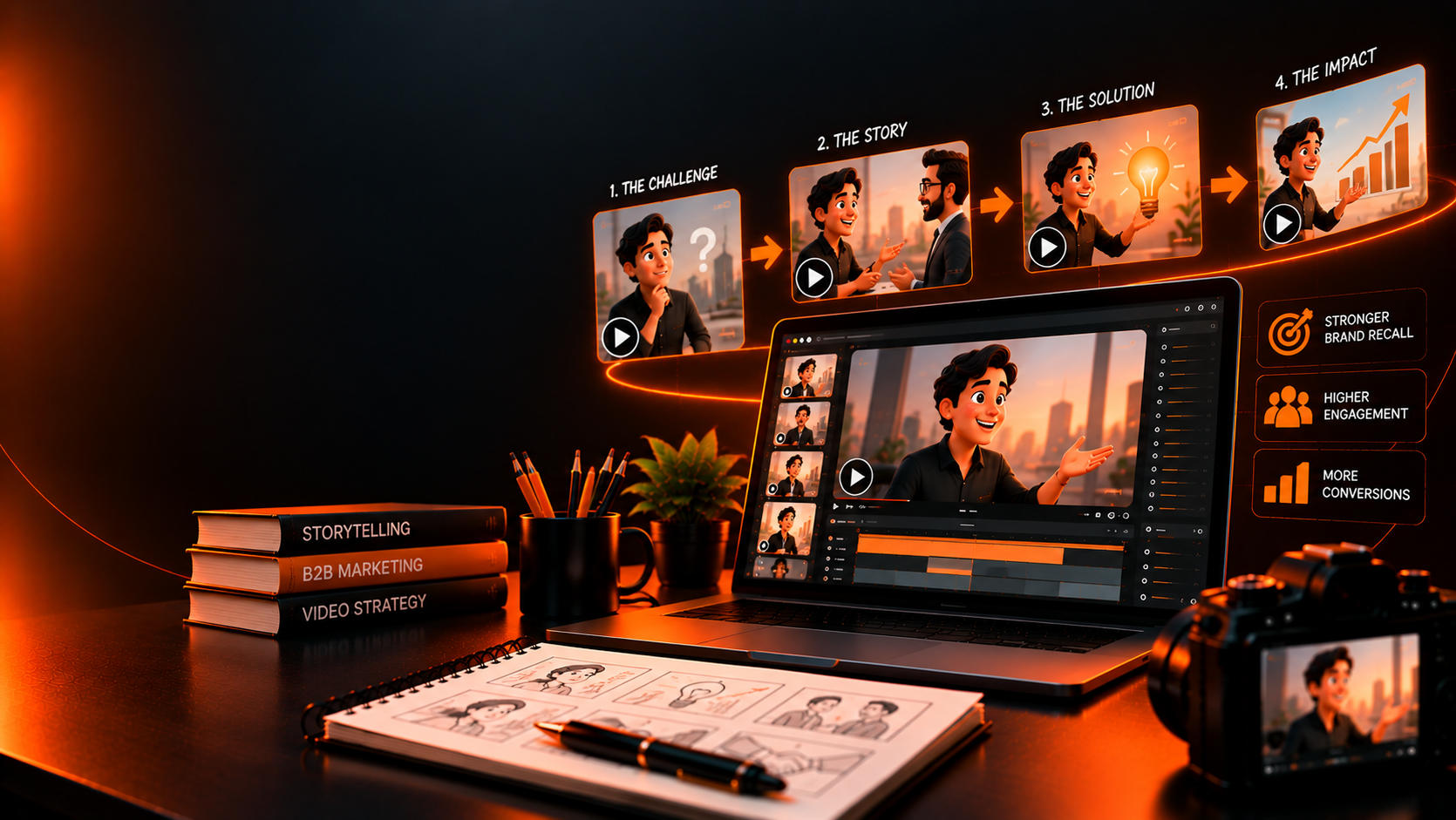
Facts don't win hearts. Stories do. Here's what video storytelling is, why it works on business buyers, and how to write a story video that sells, with 15 animated examples and the framework from our storytelling ebook by Subinder Khurana.
Video storytelling means using video to tell a story instead of listing facts: a hero, a challenge that matters and a better ending. It works in B2B because buyers decide with their heart, gut and imagination as well as their brain. The best story videos raise the stakes, show the struggle, make the customer the hero, and end on an emotional high with a clear call to action. Below are 15 animated examples we made, grouped by the storytelling lesson each one teaches.
Video storytelling is using video to tell a story rather than just present information. There's a character the audience relates to, a challenge that matters and a change by the end. Visuals, voice, music and pacing all carry the emotion, which is why video is the strongest storytelling medium most brands have.
In business, the story is rarely about the company. It's about the customer: what they want, what stands in their way and how their world looks once the problem is solved.
Storytelling in marketing is presenting your product through a story your audience sees themselves in, instead of only describing features and benefits. The product becomes the turning point in the customer's story, not the subject of a lecture.
"People do not buy goods and services. They buy relations, stories and magic." Seth Godin
Talking about features is easy. Making a viewer care is hard. And most marketing videos are boring for exactly that reason: they explain, but they don't tell a story.
Where this framework comes from. Much of this guide draws on our free storytelling ebook, written with Subinder Khurana, Chief Architect at StoryProcess. Subinder was VP (Analytics) at Cognizant, President of marketRx India and is a Venture Partner at Omnivore. He helps technology companies with their biggest challenge: engaging their audience, simplifying complex concepts and inspiring action.
Subinder describes four decision centres in the human mind. Engage two at once and your message becomes far more powerful. Engage all four and it becomes many times stronger again. Most enterprise videos only speak to the first.
Logic and data. Necessary, but on its own it's forgettable. Give just enough to support the story.
Emotion. Don't keep it uniformly positive. Like a good dessert, sweet needs a little tart. Contrast makes the high land.
The new, better world. Make the customer's goals vivid and show the human impact of reaching them.
Intuition matches patterns fast but is easily overloaded. One example, success story or analogy beats a long list of benefits.
Stories work because they reach the heart, the gut and the imagination at the same time, while carrying just enough logic to build credibility. That's why facts tell, but stories sell. For more on the emotional side, see our emotional marketing examples.
B2B storytelling is often dismissed as a consumer trick. But whatever you sell, you're selling it to people, not job titles. People with dreams, struggles and pressure from their boss.
A good B2B story video grabs attention in a crowded market, explains complex offerings simply, builds trust, shortens the sales cycle and differentiates you from competitors who all claim the same features. It also travels: sales teams share it, buyers forward it to colleagues, and it says the same thing every time. See how style choices affect the story in our guide to animation styles for B2B brand storytelling, and where stories fit in a wider video marketing strategy.
Every example below is an animated video storytelling project we produced. They're grouped by the storytelling lesson each one teaches best, from winning the heart to inspiring with purpose. Most use character animation, a few use mixed media, and one shows how whiteboard storytelling builds a story line by line. Click any card to watch.
Most B2B videos only talk to the brain. These also make people feel something and picture a better future.
A mixed-media film for Siemens about the space where the real and digital worlds meet: where a dreamer sees the factory of the future and the car is built before the car is built.
It sells a feeling of possibility, not a spec sheet. Subinder uses it in the ebook as an example of reaching past the brain to the imagination.
Describe the future your customer wants to build, then show your product as the place it happens.
PPG's asset integrity video opens with "Imagine if you could see into the future" and then shows how its system predicts corrosion before it happens.
"Imagine" is a direct invitation to the imagination. The viewer pictures the better world before hearing a single feature.
Open with what life looks like once the problem is solved. Features come second.
A one-minute brand story for Erdos Miller about engineers who work late into the night to hit targets, and the promise of getting time back for the people they love.
It's a B2B oilfield brand talking about family. That contrast between work pressure and home is the emotional hook.
Find the human cost of your customer's problem. It's rarely on the spec sheet.
A story needs something to lose. These videos make the problem feel big before the solution shows up.
It opens like a news report on the night a great town was destined to fall to the biggest fire anyone had seen. Tension first, resolution later.
The stakes are set in the first line. Subinder points to it in the ebook as a video that keeps the tension going before the climax.
Don't solve the problem in the first ten seconds. Let the viewer feel it first.
Cubic's transport analytics video starts with a single road or station closing for a day, and the ripple effect it sends across a whole network.
One small, concrete event makes an abstract data problem feel urgent and real.
Show the problem through one specific moment, not a list of statistics.
For land-management software Tracts: target acreage brimming with oil sits just out of reach, behind a labyrinth of legal documents and hand-drawn flowcharts.
The prize is visible but blocked. That gap between what you want and what stops you is the engine of every good story.
Name the prize, then name the obstacle. Your product removes the obstacle.
The viewer sees themselves in the story. The product is their superpower, and the brand is the guide.
SUSE's partner video speaks straight to IT service providers: you care for your clients, you deliver, and still it's harder than ever. Then it shows how SUSE helps them win.
It's written in the second person. The viewer is the hero from the first sentence. It also appears in the ebook.
Write your script to "you". Make the customer's struggle the plot and your product the turning point.
For sponsorship analytics platform Sponsorium. It opens on the sponsorship manager's passion and frustration, "you wish you could accomplish more", before showing what becomes possible.
One clear example and just enough product to get them curious. Subinder uses it to show how to win the gut without information overload.
Lead with the viewer's wish, not your feature list. Show just enough product to make them want more.
A busy, growing company is still interviewing contractors weeks after calling a staffing agency. People Caddie plays out the "nope, nope, nope" before offering a better way.
It acts out a frustration every hiring manager has lived. They recognise themselves and laugh before they're sold to.
Dramatise your customer's most annoying moment. Recognition builds trust faster than claims.
An epic-movie parody for tech company Skogul: workers toiling in cubes, fighting every day for a place where they're valued, until a new team rises.
It borrows the hero's journey openly and has fun with it. The viewer is the hero; the company is the place they're looking for.
Story structures are tools. Use the classic ones, even with a wink.
Nothing earns trust like a real person telling what happened to them.
A customer tells their own story: a business bought with a hidden IRS debt, a hostile tax office, unfiled returns and the stress that followed, until M&M stepped in.
It's first-person and specific. Real details make it believable in a way no claim can.
Turn your best customer story into a short animated video. Keep their words.
An HVAC technician's story, starting with fishing trips with his dad and ending with buying his first home at 25, made for Shapiro & Duncan's recruitment.
It's a career told as a life story. The company is the guide that made the dream possible.
For recruitment videos and employer brand films, tell one person's journey instead of listing benefits.
The best stories go past ROI and give people a reason to care.
A whiteboard story for Christian Church Homes that opens with Margaret Mead's line about small groups changing the world, then tells how a handful of church leaders built affordable senior housing.
It starts with why. Purpose comes before process, so every fact that follows means more.
Open with the belief behind your company. Whiteboard storytelling suits stories told step by step. See more whiteboard explainer videos or our whiteboard animation work.
A mixed-media partner story for Lenovo about decades of powering innovation and a promise to help partners accomplish more.
It frames the partnership as a shared mission, not a transaction.
In partner and channel videos, sell the future you'll build together.
For the National Recreation and Park Association: parks and recreation spaces should be open and welcoming to everyone, no matter ability, age, gender identity or ethnicity.
It ties practical best practices to a bigger purpose, so the viewer wants to act on them.
Even a how-to video can inspire. Tell people why the change matters, then how to make it.
These are the core video storytelling techniques from the storytelling ebook, in the order you'd use them.
Before production, map the story visually. Our guides to storyboarding and writing an explainer video script cover the next steps, and our video hook ideas help with the opening seconds.
Viewers decide in seconds whether a video is for them. Promise something worth their time, then deliver it.
Give direction for visuals, voice, colour, captions and music, not just the words.
Name the core emotion (optimism, excitement, peace of mind), add a contrasting one, and flag both for the production team.
A voiceover is heard, not read. Use short, simple, linear sentences.
A minute of voiceover is 120 to 140 words. For a two-minute video, aim for under 250 words.
Test every line: does it help the viewer or just impress? Is it a real insight? Could it wait for a later sales stage? When in doubt, cut.
Scripts that arrive for review are almost always too long, often by three times. The job of a two-minute video is to make the viewer want to learn more, not to tell them everything. For whiteboard formats, see how to write a whiteboard video script.
Trust is the condition every sale depends on. Subinder describes three levels:
To reach that third level, he suggests this framework for a strategic story:
It works as a sales story as well as a video script. And show your passion for the right thing: the customer's outcome, not your technology or winning the deal. Real customer stories help too. Browse our video testimonial examples.
Inspiring stories share three things: purpose, risk and transformation. Astronauts' daily work is mostly checklists and process, yet it inspires us because it means something. Great goals come with real risk, which shows how much they matter. And inspiring causes make people, industries and even the world better.
For business videos, that means going past data. Good products talk about features. Great products talk about outcomes and ROI. The products people remember inspire us to be more. Keep the technology as the supporting cast and make the customer a visionary hero. For inspiration from other brands, see our brand storytelling video examples.
ROI arguments can only stretch a price so far, because every extra dollar eats into the saving you promised. People pay a premium for other things: peace of mind, status and new capabilities that let them imagine new possibilities. Enterprises do this too, with prime offices, consultants and digital transformation.
The catch is that intangible benefits are hard to explain, and more data too early only adds complexity. A story helps buyers understand why your offering matters and what it makes possible, so the detail lands when they're ready for it. That's how you move from commodity to premium. Want to know what a story video costs? See our explainer video cost breakdown.

Video storytelling is using video to tell a story rather than list facts. There's a character, a challenge and a change, and the viewer comes away feeling something. In marketing, the customer is usually the hero and the product helps them win.
Storytelling in marketing means presenting your product through a story your audience relates to, with a relatable character, a problem that matters and a better ending, instead of only describing features and benefits.
B2B buyers are still people. Stories engage emotion, intuition and imagination as well as logic, which makes a message easier to remember and trust. They also simplify complex products, which matters when several stakeholders need to understand and agree.
Most B2B story videos work best under two minutes. A voiceover runs about 120 to 140 words a minute, so aim for under 250 words of script for a two-minute video.
High stakes, a struggle before the solution, a hero the audience relates to, a mix of emotions rather than nonstop positivity, just enough evidence to be credible, and an ending on an emotional high with a clear call to action.
Yes. Animated video storytelling can show ideas, systems and futures that are hard to film, create characters anyone can relate to, and keep complex B2B stories simple.
At Broadcast2World, a 60-second animated video starts at about $3,000 in our Basic style. A 30-second video costs about half, and 90 seconds is about 1.3 times the 60-second price.
Everyone has a story, and every business has one worth telling. Make it about your customer, give it real stakes, let the struggle show and end on a high. If you want to go deeper, download our free storytelling ebook by Subinder Khurana, browse more of our work in the portfolio, explore our explainer video production and 2D animation services, or head back to the Broadcast2World homepage.
Marcus is a distinguished artist with a deep-rooted passion for visual storytelling. Graduating with a degree in Art from a prestigious institution in the USA, he has seamlessly blended his artistic prowess with the digital world, specializing in video marketing and animation. His innovative approach in these fields has seen him contribute to several renowned platforms, where he elucidates on the nuances of effective visual communication. Outside of his professional sphere, Marcus is an avid biker, often taking to the open roads to find inspiration and reflect on his creative ventures. Merging artistry with strategic insights, Marcus continues to shape the landscape of video marketing, one animation at a time.
We've made 2,400+ animated videos for startups and Fortune 500 brands, including story-led films for Siemens, SUSE, PPG and Lenovo. Tell us what you sell and we'll help you find the story in it.
US Office (Support)
371 Hoes Lane, Suite 200, Piscataway, New Jersey - 08854
US (Toll Free): 1800-571-2725
(Render 5 Technologies Pvt. Ltd.)
India Office (Production)
WeWork, 246, Udyog Vihar,
Gurugram, Haryana - 122016
IND: (+91) 98713 30069
SERVICES
ANIMATION STYLES
INDUSTRY
Copyright © 2026 Broadcast2World, Inc. All Rights Reserved.
No Comments Yet
Let us know what you think