
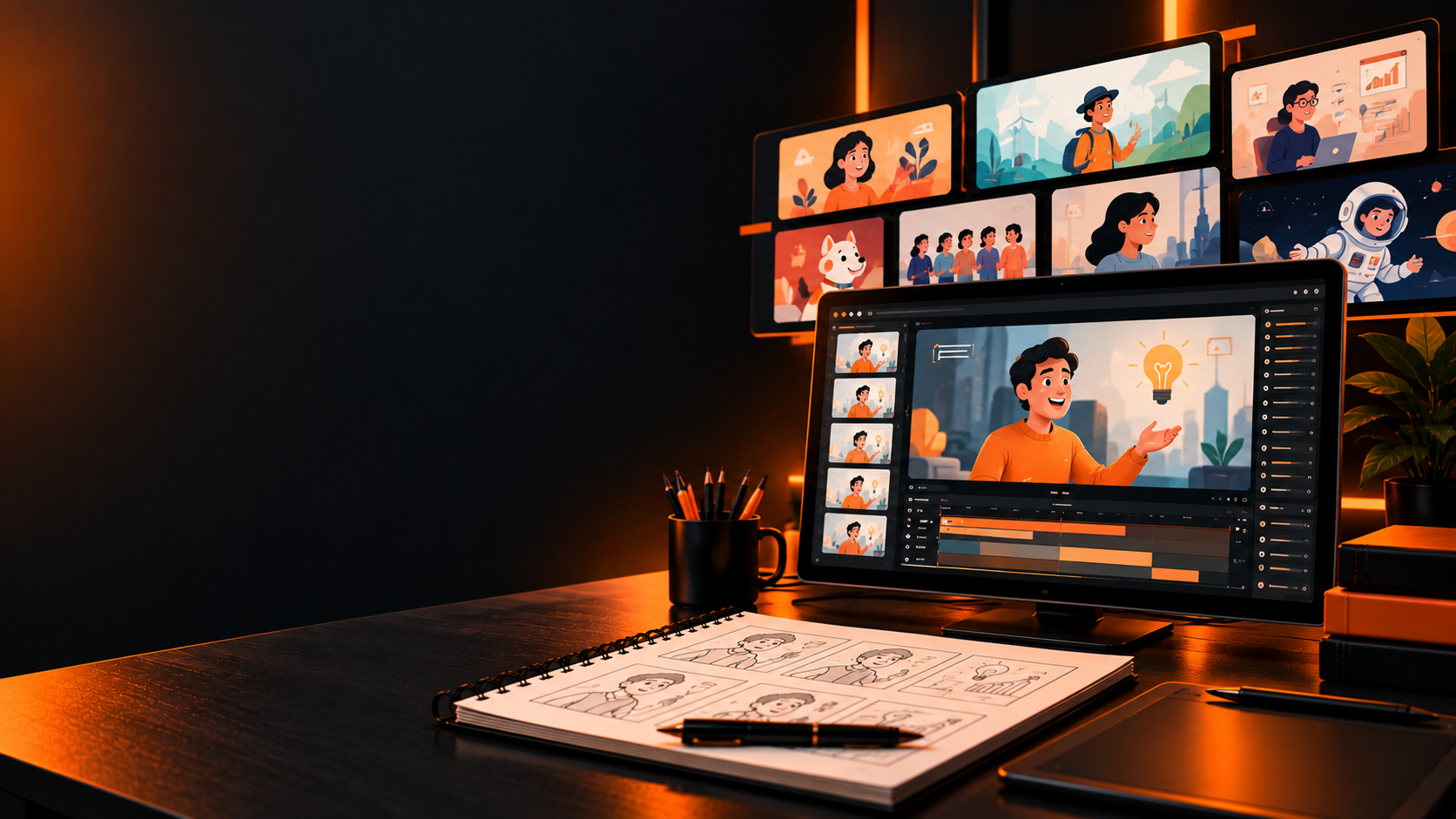

15 real 2D animation examples from brands like VISA, Amazon, Atlassian, Hootsuite, and Mailchimp — plus what is 2D animation, its production process, 6 core styles, and a straight comparison against 3D and whiteboard animation. Every example below is a real, currently-produced explainer video, broken down for why the brand made it, how it's styled, and why it actually works.
Who knew the captivating world of 2D animation, now a staple in entertainment, had roots burrowing all the way back to the 1800s? Since then, this versatile medium has blossomed into a powerful tool not just for TV shows and video games, but for B2B brands too.
It's perfect for breaking down complex concepts or showcasing product demos in an easy-to-understand and visually engaging way. With 2D animation videos, businesses can tell compelling stories, evoke emotions, and deliver clear, impactful brand messages.
Let's dive into what 2D animation is, how it works, its role in B2B branding, and 15 real examples worth studying.
2D animation is a form of drawn animation that works by creating the illusion of movement in a flat, two-dimensional space — where characters and scenes are crafted frame by frame, either by hand or digitally.
Unlike 3D animation, where characters and objects move through a three-dimensional world, 2D animation is limited to up, down, left, and right movements. It gives the illusion of depth without actually having any elements on the z-axis — there's a clear difference between 3D and 2D animation, covered in more detail further down this page.
Every 2D animation video — including all 15 examples below — moves through the same three production stages.
Concept artists design characters, sketch backgrounds, and build storyboards — the comic-strip-like blueprint for the entire animation.
Digital artists build assets from the pre-production designs — characters, backgrounds, props — then animate keyframes in software like After Effects and sync dialogue to mouth movement.
Rough animation gets cleaned up, colored, and combined with backgrounds. Tweens smooth the transitions between keyframes, then sound design and editing finish the video.
To achieve that captivating 2D animation look, artists rely on a handful of core techniques. Here are the six most common:
Each frame is hand-drawn. Though painstaking, the way this process brings the animated world and characters to life is truly captivating — each character or element movement is crafted frame by frame, resulting in a timeless piece that's both expressive and fluid.
Flat shapes — usually made from fabric, paper, or digital assets — are brought to life through frame-by-frame movement. Their movement gives a storybook-like feel to viewers.
Used to give 3D-like depth on a budget. Objects are drawn from a specific angle, often 30 or 45 degrees, to create the illusion of dimension — used in explainer videos, infographics, and even video games for an immersive feel without actual 3D rendering.
Animators use tools like After Effects, Adobe Animate, or Toon Boom Harmony instead of drawing each frame manually, applying rigging, tweening, and vector graphics for smooth, precise, scalable motion — the classic 2D charm, produced faster.
Motion graphics animates shapes, text, icons, and data — not characters. It's the go-to style for SaaS product explainers and data-driven B2B content because it can visualize abstract concepts like workflows, growth, and integrations without needing a character-driven story.
A hand-drawn, sketch-style animation typically shown against a plain white background, often paired with a hand appearing to draw each element in real time. Especially effective for step-by-step or educational explainers where clarity matters more than visual flair.
See more in our roundup of top whiteboard explainer videos.
Other 2D animation types you'll come across: screencast animation, typography animation, rotoscope animation, zoetrope animation, clay animation, and retro animation.
All three are common explainer-video formats, but they solve different problems. Here's how they stack up:
| Factor | 2D Animation | 3D Animation | Whiteboard Animation |
|---|---|---|---|
| Typical cost | Lowest of the three | Highest — modeling and rendering add time | Low, often close to 2D |
| Typical timeline | Shortest turnaround | Longest — rendering is time-intensive | Comparable to 2D |
| Best for | Brand storytelling, B2B explainers, social content | Product demos needing realistic depth (medical devices, industrial equipment) | Step-by-step or educational content, simplifying a single concept |
| Visual style | Flat or stylized characters and scenes | Photorealistic or stylized depth and lighting | Hand-drawn sketch look, usually monochrome |
| Emotional range | Highest — characters and color carry tone easily | Strong for realism, less for stylization | Limited — best for clarity over emotion |
If you're still deciding, most B2B brands start with 2D animation because it balances cost, timeline, and storytelling flexibility better than the other two. For a deeper breakdown of the first two, see our full 2D vs. 3D animation comparison.
68% of consumers prefer watching videos to learn about new products or services rather than reading ebooks or articles — and 2D animation is one of the most affordable, effective ways to meet that preference.
Seeing examples helps more than reading definitions. Here are 15 real 2D animation videos in active use today, and what makes each one work.
VISA used this 2D infographic video to explain VisaNet +AI — how the solution uses artificial intelligence to deliver smarter authorization, clearing, and settlement for consumers, banks, and merchants. It packs in isometric bar graphs, dotted-line data charts, and spiraling transactional data streams, playing with angles and shading to create a 3D illusion inside a fully 2D space.
Real professional use cases (an operations manager, a project manager) show the AI resolving actual problems, backed by dynamic motion graphics and a futuristic robotic voiceover.
2D infographic with a 3D-illusion layering technique — flat elements shift onto separate visual planes mid-scene.
RBS highlights the pain of getting construction invoices processed on time, then explains how its team of industry experts solves it. The video blends 2D cut-out animation with a whiteboard format — flat cut-outs of people and objects unfold like a greeting card, with a hand cut-out manipulating elements across each scene.
The unfolding-paper visual makes viewers curious to keep watching, while collaborative scenes between business owners and the RBS team build credibility.
Light and shade separate flat cut-outs from the background; a restrained orange-accented palette keeps focus on the story.
Metomic highlights the risk of sensitive data leaking across a company's SaaS stack, then positions itself as the fix — protecting that data without slowing employees down. Simple, faceless characters, fast screencast animation of a real Slack integration, and a mix of solid and holographic color elements carry the story.
It opens on a relatable problem (data exposure), then proves the fix with a real product screencast rather than just narration.
Isometric angle play creates a 3D illusion inside otherwise flat, minimal 2D character work.
TOMS built this video to explain its "One for One" model — for every pair of shoes sold, a pair is given to a child in need — and how that idea grew from a founder's trip to Argentina into a company-wide giving movement. It's an origin story used as a brand-values explainer, not a product demo, with Character-style animation carrying the founder's own narration scene by scene.
It sells a value system before ever mentioning the product — a strong reference for any retail or consumer brand differentiating on values through brand storytelling.
Character-driven 2D animation following a real narrative timeline, from "10,000 pairs given away" to a company-wide giving department.
Symetria uses simple 2D motion graphics and connective diagrams to explain personal blockchains and position itself as the first cryptocurrency wallet and exchange to implement them. There's no detailed character animation — just clean, geometric illustrations of a human/user icon in a green-and-orange palette.
A hard concept (blockchain) gets broken into simple symbolism — a user icon, a briefcase, changing icons for eye/meter/shield representing private, fast, protected.
Clean, minimal, geometric motion graphics with a deliberately restrained two-color palette.
Mailchimp reemphasizes how it's a business's go-to for every marketing need, using deliberately rough, hand-drawn 2D cartoons in black against its classic yellow background. A pencil-like drawing of a hand holding a wind chime, with doodles (a bulb, a cloud, an arrow) dangling from the strings, carries the whole metaphor.
Humor and wit make it memorable — the witty voiceover payoff and a wink from the Mailchimp monkey seal the emotional close.
Intentionally rough, crooked hand-drawn lines set it apart from over-polished marketing videos.
Amazon shows how easy it is to connect smart home products with Alexa, following an animated character through her daily life — at home, away, at the gym, checking who's at the door — as the devices help along the way. Subtle shadow and angle play adds a sense of depth to otherwise simple 2D character animation.
Real, everyday scenarios explain technical benefits in plain language and clear visuals — no jargon required.
Character animation with subtle color and camera work (tilt/pan) rather than fast, flashy transitions.
Atlassian tackles the pain of juggling multiple work tools by demonstrating each app in its cloud platform — Goals, Teams, Analytics — in a mixed-media approach blending 2D animation, screencasts, and real photography.
Mixed media: 2D animation, screencast capture, and live photography combined in one piece.
Character animation with subtle color and camera work (tilt/pan) rather than fast, flashy transitions.
Vanderbilt University promotes its "I Love VU Week" program by blending 2D motion graphics with real live-action campus footage in small collage-like elements, paired with fast kinetic typography and text callouts.
Real student and faculty footage plus energetic music and voiceover make campus enthusiasm feel authentic, not staged.
Mixed media — live-action clips layered over a 2D motion graphics background.
McDonald's Brazil celebrates World Car-Free Day by encouraging customers to visit the Drive-Thru via eco-friendly transportation — skateboards, horses, turtles, even bathtubs — using a wide variety of animated cartoon character styles across dreamlike, fantastical scenes.
Sheer creativity positions the brand as socially responsible while staying true to its fun, playful identity.
Varied 2D cartoon styles — video-game-like, Disney-princess-like, black-and-white — mixed within one piece.
Spotify uses flat 2D vector illustrations to show how effortlessly "Ads by Anchor" lets podcasters create and manage ads — stylized characters with minimal detail, in an on-brand green-and-navy palette.
It's concise — in about one minute, relatable scenarios demonstrate exactly how simple the tool is to use.
Simple flat-style vector illustration with a tightly controlled two-color brand palette.
Hootsuite highlights how hard it is to stand out on social media, then walks through its features — scheduling, analytics, integrations — in detail. Colorful gradients, loosely drawn smiley-faced characters, and creative 2D screencasts carry an unexpectedly funny tone throughout.
Humor (a cat using Snapchat filters, an absurd horse-riding stunt) earns attention, then animated hands walk through each real feature.
Motion graphics and 2D screencast blended with playful, loosely drawn characters and gradient color work.
CircleCI explains why teams need resilience-building tools, then backs it up with named case studies — Condé Nast, Wired, GQ, Vogue — over animated orbital diagrams and cube structures in a neon palette against black.
Real, named brand results (not just promises) paired with a serious, credible voiceover build trust before the final call to action.
2D motion graphics with a high-contrast neon-on-black palette.
Icedrive explains how its cloud storage and collaboration tools make file sharing easy, using 2D isometric animation — office setups, people, and icons all drawn from an angle that creates the illusion of 3D depth.
It opens by naming the pain point, earns trust, then walks through the product's features in action.
Isometric 2D animation with occasional screencast and motion graphics elements.
Erdos Miller designs custom-tailored electronic engineering solutions for companies racing against deadlines. Instead of listing technical specs, the brand built this video around a relatable problem — engineering teams working late into the night just to hit targets — and made the case that the right partner buys that time back, positioning itself as an extension of the client's own team.
Most industrial explainers default to feature lists. This one leads with the human cost of a bad engineering partner first, capability second — the same principle behind any strong B2B explainer video.
Character-style 2D animation built around a warm, direct voiceover rather than dense on-screen data.
We understand businesses, their pain points, and their unique needs. With our custom 2D animation services, we help you break down complex offerings, build credibility, and motivate prospects to take action.
We have a track record of creating successful 2D animation videos for brands like SUSE, Factspread, Fujitsu, Sponsorium, and more. We're also efficient on pricing — premium service within your budget — and now offer AI-assisted video production, combining the speed and precision of AI with the soul of handcrafted storytelling to produce animated explainer videos.
Yes, 2D animation is built on drawing. Each frame is created to produce the illusion of movement, either traditionally by hand or digitally using tools like Adobe Animate or Toon Boom Harmony — modern tools speed up the process while keeping the artistic essence of traditional drawing intact.
Yes, it can be challenging at first — mastering 2D animation takes a solid understanding of drawing, movement, and timing. If your in-house team isn't well-versed in animation, hiring experts like Broadcast2World can bring your vision to life more efficiently.
Use 2D animation when you want to make complex ideas easy to understand or tell a story engagingly within a budget — it fits explainer videos, commercials, educational content, and social media posts alike.
It depends on use case, target audience, core message, marketing funnel, style, and script complexity — a 2D animation video can run anywhere from 15 seconds to 90+ seconds depending on those factors.
Yes, anime is a distinct style of 2D animation that originated in Japan, known for hand-drawn or digitally created visuals, vibrant palettes, and expressive storytelling — its cultural influence sets it apart as its own recognizable genre.
Pricing depends heavily on video length, style complexity, and script/storyboard revisions, but 2D animation is generally the most budget-friendly explainer video format compared to 3D or live-action. Simpler styles (whiteboard, basic motion graphics) sit at the lower end; custom character-driven videos cost more due to the added design and animation work.
Most 2D animation explainer videos take a few weeks from script to final delivery — covering scripting, storyboarding, illustration, animation, and revisions. Timelines stretch for longer videos, more complex character work, or multiple rounds of stakeholder feedback.
Is 2D animation still magical? Absolutely. Brands are using it in exciting and creative ways, showing that the style can be both extraordinary and versatile — there's still plenty of potential here for your B2B branding too.
With advances in AR, VR, and the boom in digital content, there are new opportunities on the horizon. Despite a few challenges, 2D animation's ongoing popularity suggests it will stay a vital, innovative medium for years to come.
You can dive into this style yourself using the tips from this guide, or leave it to professional agencies that provide 2D animation services. Either way, don't miss out on using the charm of 2D animation in your marketing content.

Anshu is a writer at Broadcast2World with a deep love for animated storytelling. With a background in Journalism and Mass Communication, she understands all the ins and outs of video production and marketing. Having authored hundreds of articles on video marketing, she’s always exploring fresh ideas and insights to help brands level up their marketing game. When she’s not geeking out over animation and marketing, you’ll find her immersed in a non-fiction book, always eager to learn something new.
Tell us your message, budget, and timeline — we'll recommend the right 2D animation style and handle production end to end.
US Office (Support)
371 Hoes Lane, Suite 200, Piscataway, New Jersey - 08854
US (Toll Free): 1800-571-2725
(Render 5 Technologies Pvt. Ltd.)
India Office (Production)
WeWork, 246, Udyog Vihar,
Gurugram, Haryana - 122016
IND: (+91) 98713 30069
SERVICES
ANIMATION STYLES
INDUSTRY
Copyright © 2026 Broadcast2World, Inc. All Rights Reserved.
No Comments Yet
Let us know what you think